


We've all been told that checklists are the answer!... tick this and your quality will be great, but have you checked in with your team? Are they sick of ticking boxes? Are you really sure your quality checks achieve what you need them to? Maybe it's time to reinvent your quality control system and fix up your check process to make it mor...
Understanding exactly what you need to do in order to achieve ISO9001:2015 can be a bit of a challenge. Sometimes the language in the standard can be a little, well, unclear. Don't get me wrong the 2015 version of the ISO9001 standard is vastly improved over the previous versions of the standard but unless you are familiar with ISO standards a...
We've posted previously about the frustration of badly managed change in a business, but what makes a truly useful change management system? Small teams can manage change reasonably simply, but once you start growing into multiple departments with multiple staff, it can be very hard to always get those needed in a room together to hash out every ch...
A lot of the time when you ask companies about their ISO9000 compliance they are ever so eager to show you their quality statistics, the Xbar charts and a multitude of other charts, talk about their outgoing and incoming quality checks and of course customer returns levels. All of which is great, but that's only a part of ISO9000 and some would arg...
In our last post we pointed out that skipping the initial sections of the ISO9000 standard is dumb, it's like walking into the movies after the first 30 minutes and hoping you know what's going on so if you haven't read our post on the initial clauses pop back there and have a read, we'll wait. ISO9000 and The Initial Clauses (the one'...
Clause 4 if the ISO9001:2015 standard is broken into 4 sections in a bid to make it cleared, for the user which are: 4.1 Understanding the Organisation & its Context4.2 Understanding the needs & expectations of interested parties4.3 Determining the scope of the quality management system4.4 quality management system & it's processes Now,...
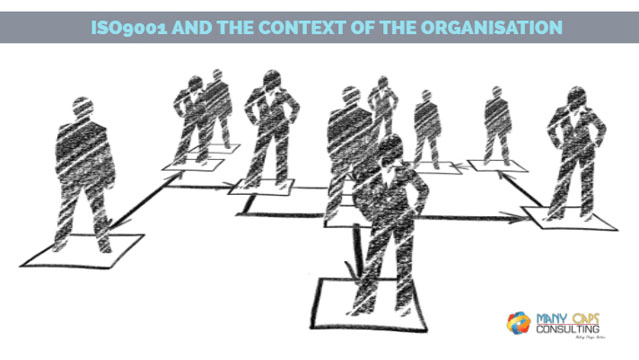
Clause 4.1 of the ISO9001:2015 standard is a new and can cause a fair bit of confusion, hand wringing and general bewilderment for people, I know when I first read it I thought WHAT THE!? but then I read it again (and again) and did some research and thought, actually I see what they are doing here, that's pretty helpful, I can see how any organisation would benefit from it so here's my take on it, hopefully it helps.
ISO 9001:2015 Clause 4.4 is an interesting one, it says that you shall establish, implement, maintain and continually improve a quality management system. It says you should include the processes needed & their interactions as well, its your job to determine the processes that are needed to meet the standard. It doesn't say anywhere ...
ISO9001:2015 Clause 4.3 is all about the scope of your Quality Management System, of what parts of your organisation will be included within your Quality Management System, in other words what are the boundaries of the Quality System. By completing ISO9001:2015 Clauses 4.1(Context of the Organisation) , Clause 4.2(Interested parties) ...
In ISO9001:2008 we had Management Responsibility, in ISO9001:2015 however we have Leadership as a clause, surely, it's just a simple name change, branding if you like. Actually no, it's quite a deliberate distinction they have made in the standard and it's aimed at engaging more of the company. Previously a company would hire a Quality Manager and ...
By accepting you will be accessing a service provided by a third-party external to https://mail.manycaps.com/